The following two abstracts will be presented in the upcoming GSA Southeastern Section Meeting in San Juan, Puerto Rico.
TIMING OF CRYSTALLIZATION AND EMPLACEMENT OF THE TWO-PYROXENE BASALT IN SOUTHWESTERN PUERTO RICO FROM CROSS-CUTTING RELATIONSHIPS AND AR40/AR39 DATING
LAÓ-DÁVILA, Daniel A., Boone Pickens School of Geology, Oklahoma State University, 105 Noble Research Center, Stillwater, OK 74078 and LLERANDI-ROMÁN, Pablo A., Geology Dept, Grand Valley State University, 118 Padnos Hall of Science, One Campus Drive, Allendale, MI 49401-9403, llerandp@gvsu.edu
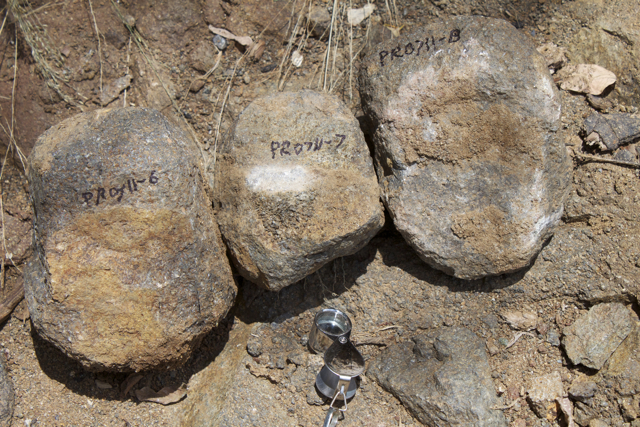
The Two-Pyroxene Basalt (TPB), also known as the Río Loco Formation, is a porphyritic basaltic- andesitic rock exposed near Mesozoic serpentinite in southwestern Puerto Rico. Studies have suggested a wide range of ages (early Campanian and Late Cretaceous-Paleogene) of crystallization and emplacement of this rock. In addition, none of the previous studies used radiometric dating to determine the age of the TPB, relying instead upon field relationships and geochemical comparisons with other units. In our study, we conducted a field and isotopic study of the TPB to constrain its age of crystallization and mode of emplacement. Field observations indicate that the TPB intrudes both the Late Cretaceous rocks and a thrust fault between the Monte del Estado serpentinite and the Yauco and Sabana Grande formations. Two samples of the TPB were collected at this thrust fault for
Ar40/Ar39 analysis. Results indicate crystallization ages for plagioclase in the matrix ranging from 44-53 Ma in one sample and 48 Ma for the plagioclase in the other sample. This indicates that the TPB crystallized within the middle- and early-Eocene, which is much younger than previously thought. In addition, the cooling and emplacement of the TPB constrains the age of serpentinite thrusting from late Maastrichtian to middle-Eocene, prior to the collision of the Caribbean Plate with the North American Plate in the late-Eocene. This result supports the hypothesis that an earlier collision at the Caribbean-North American Plate Boundary occurred in the early Paleogene. Moreover, it suggests that geochemical evolution models that used the TPB must be revised in light of the younger ages indicated in this study.
USING A GEOSCIENCE BLOG TO PROVIDE RESEARCH-BASED, CONTEXTUAL, AND CULTURALLY-RELEVANT GEOSCIENCE INFORMATION TO A SPANISH- SPEAKING AUDIENCE
LLERANDI-ROMÁN, Pablo A., Geology Dept, Grand Valley State University, 118 Padnos Hall of Science, One Campus Drive, Allendale, MI 49401-9403, llerandp@gvsu.edu and LAÓ-DÁVILA, Daniel A., Boone Pickens School of Geology, Oklahoma State University, 105 Noble Research Center, Stillwater, OK 74078
Formal geoscience education in Puerto Rico has traditionally relied upon the use of textbook and curricular materials translated from the English language and focused on geoenvironmental and cultural contexts foreign to the Caribbean. Informal geoscience education for the Spanish-speaking general public is also mostly translated from English and scarcely found in traditional (e.g. newspapers) and newer media outlets (e.g. news websites and opinion or journalistic-style blogs). The lack of culturally-relevant and contextual geoscience information available to the public led us to develop a geoscience dissemination blog aimed to provide reliable, research-based, geoscience information to a Spanish-speaking audience. This blog, called Ciencias Terrestres, Geología y Puerto Rico (CTGP; http://geolpr.wordpress.com/), is not based on the authors’ opinions or the publication of science news posted elsewhere. The articles in CTGP are: an original contribution of the authors, written in Spanish, focused on an audience that understands concepts at the middle school – introductory college level, supported by primary and secondary science literature, and pertinent to the circum-Caribbean region. The blog is disseminated through social media sites, such as Facebook and Twitter, and online science communities (e.g. CienciaPR) and news outlets. The blog is also listed in several educational websites, and in Puerto Rican and international blog directories. Blog statistics show that more than 35,000 people, from over 65 countries, have accessed articles in 19 months. The most popular topics are ocean currents, geohazards, and the nature of geoscience. A recent audience survey show that readers are interested in enhancing their general understanding of geoscience concepts, searching for information to work on secondary school projects, and learning about the geology of their country. These results suggest that the blog’s audience finds meaning in accessing the site. Results also encourage us to further our contributions, develop partnerships with future collaborators that may diversify the perspectives and articles published, and develop new assessments to understand and serve our audience. Our paper explains the CTGP model and discusses the challenges and future directions of geoscience blogging.

