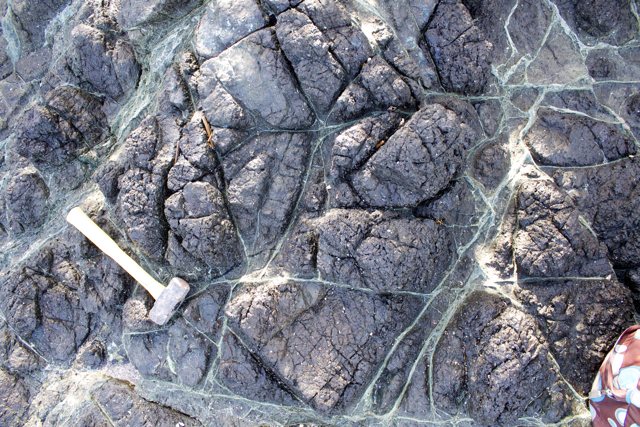
 Our abstract titled: “Fracture patterns formed from hydration in serpentinite from Mayaguez, Puerto Rico” has been accepted for presentation in this year’s American Geophysical Union Annual Meeting in San Francisco, California. Erin Roehrig will be presenting a poster of our later discoveries from our study in the serpentinite. The abstract is shown below:
Fracture patterns formed from hydration in serpentinite from Mayaguez, Puerto Rico
Daniel A Lao Davila, Erin Roehrig
Boone Pickens School of Geology, Oklahoma State University
Fractures formed by volume increase of peridotite during serpentinization make up polygonal patterns that are distinct from fractures formed by other processes. In order to better understand the formation and characteristics of these fracture patterns and discriminate between fractures that formed by different processes, we studied well-exposed fractures in three coastal outcrops of the Río Guanajibo serpentinite body in Mayagüez, Puerto Rico. The aims are to identify the fractures formed by serpentinization and fractures formed by other processes (i.e. tectonic stresses) and characterize their spatial attributes. This is important to improve deformation and tectonic models of regions and to better understand fracture network characteristics in serpentinite and how they are related to fluid flow. In addition, this study aims to enhance the understanding of in situ peridotite carbonation. This ‘reaction-driven’ cracking and the formation and propagation of fractures are important for comprehension of rates and processes involved in peridotite carbonation.
At the meso-scale, we described fracture properties, such as length, spacing, cross-cutting relationships, and location within the core-rim structures. Our observations suggest fracture generations are associated with explicit processes. From knowledge of the processes involved in serpentinization, and each generations attributes we can infer generation relationships, fracture formation and propagation. We also collected samples for micro-scale analyses of fractures, some of which include Scanning Electron Microscopy, Transmission Electron Microscopy and X-ray Diffraction. The mineralogy of the serpentinite will provide clues to the environmental conditions of the metamorphism. A Riegl Terrestial LiDAR was used to image the fracture patterns in 3D. Creating planar surfaces from fractures and manipulating high resolution data will help to expose patterns in fracture formations. Contributions of this study will increase knowledge of propagation and rate of formation of fractures in serpentinites and their impact on in situ peridotite carbonation.

