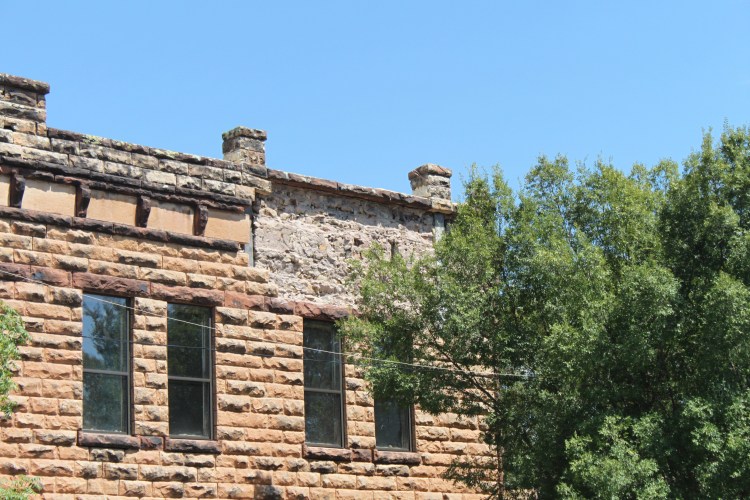
 Our new paper was presented at the AEI Conference in Oklahoma City. You can access the it here.
Summary of the project:
Induced earthquakes constitute a hazard to Oklahoma buildings. Oklahoma averaged about 1 earthquake magnitude ≥3 per year from 1974 to 2008. However, over 100 earthquakes magnitude ≥3 occurred per year in 2013 and 2014. Based on the average of horizontal spectral response acceleration for 1.0-second period and peak ground acceleration, the U.S. Geological Survey (USGS) forecasts a Modified Mercalli Intensity of VI to greater than VIII and a chance of damage from an earthquake of 1-12% for 2016. This forecast prompts the following questions: (1) Which buildings are at risk due to their physical characteristics and location?, and (2) Which buildings would be difficult to replace? The purpose of this paper is to assess the vulnerability of buildings on the National Register for Historic Places in Oklahoma with the highest risk for earthquake damage (10–12%) as indicated by several maps, including USGS seismic hazard maps for tectonic and induced earthquakes. Thirteen buildings on the National Register are located within or adjacent to the highest risk area in northwest Oklahoma determined by an interdisciplinary team consisting of an architect, a geologist, and an architectural engineer. Using FEMA P-154 Rapid Visual Screening of Buildings for Potential Seismic Hazards, the team assesses these buildings for earthquake vulnerability. Assessment begins with a search of the Sanborn maps, which provide information about older buildings’ physical characteristics. Soil type, which affects the transfer of earthquake energy, is also taken into consideration. Assessment continues with a visual screening of other characteristics, including type of construction and openness of the ground floor. Buildings are scored per FEMA P-154, which can lead to a recommendation for further study. Based on this study, there is the potential to expand an assessment of hundreds of historic buildings in Oklahoma in high-risk areas – See more at: http://ascelibrary.org/doi/abs/10.1061/9780784480502.077#sthash.sIkaUhrh.dpuf

