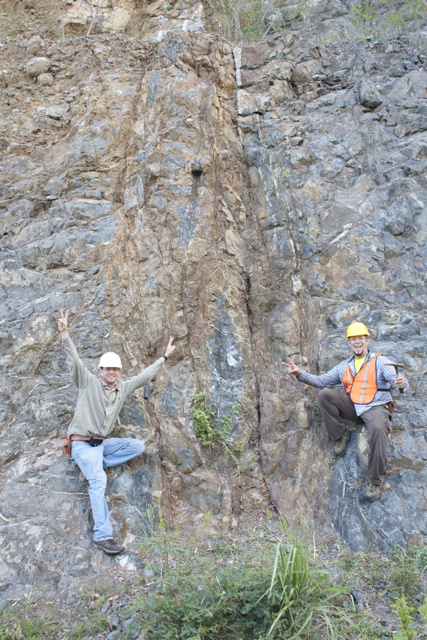
| LAÓ-DÁVILA, Daniel A., Boone Pickens School of Geology, Oklahoma State University, 105 Noble Research Center, Stillwater, OK 74078-3031, daniel.lao_davila@okstate.edu and LLERANDI-ROMÁN, Pablo A., Geology Dept and Integrated Science Program, Grand Valley State University, 118 Padnos Hall of Science, One Campus Drive, Allendale, MI 49401-9403The Río Guanajibo Fold-and-Thrust Belt, composed of Cretaceous serpentinite and volcano-sedimentary rocks, represents the deformation front of a contractional event in SW Puerto Rico during the Paleocene. Previous studies inferred structural and stratigraphic relationships from poorly exposed outcrops. New road cuts along Road 122 in Lajas exposed the Yauco (YF) and El Rayo Formations (ERF) providing insights on the deformation of the hanging wall and footwall of the fold-and-thrust belt. We described the nature and orientation of faults and folds, and analyzed the kinematics using striations, offset layers, and S-C foliations to characterize the deformation. The YF occurs in the hanging wall and shows a sequence of folded, medium-bedded mudstone and thinly bedded shale and sandstone. Major folds strike NW-SE and are gentle with steeply inclined axial planes and sub-horizontal fold axes. Minor folds are open with moderately inclined axial planes and gently-to-moderately inclined SE plunging fold axes. Dip-parallel striations on folded strata and S-C foliations in shale layers suggest reverse faults with NW-SE strike. Steep left-lateral faults strike NW-SE and NE-SW, and right-lateral strike-slip faults strike NNE-SSW. At the footwall, the ERF consists of steeply inclined bioclastic limestone and polymictic orthoconglomerates and paraconglomerates. Steeply inclined reverse and strike-slip faults cut along stratigraphic contacts. Fault breccia and thrust duplexes occur in major fault zones. These results suggest that the hanging wall and footwall accommodated strain along preexisting weaknesses. Kinematic analysis suggests that NE-SW directed shortening was partitioned between folding and interlayer shortening, accommodated by flexural slip, and steep strike-slip faults that resulted from transpression. Shallow thrust faults are lacking. However, steep faults may become shallower at depth and join with sub-horizontal detachment faults. |